Old towns · Kawagoe
Kawagoe's clay-walled street, before the crowds
Half an hour from Ikebukuro, a street of black fireproof storehouses, a wooden bell tower and a temple yard of five hundred stone faces. Come early and the town is still yours.
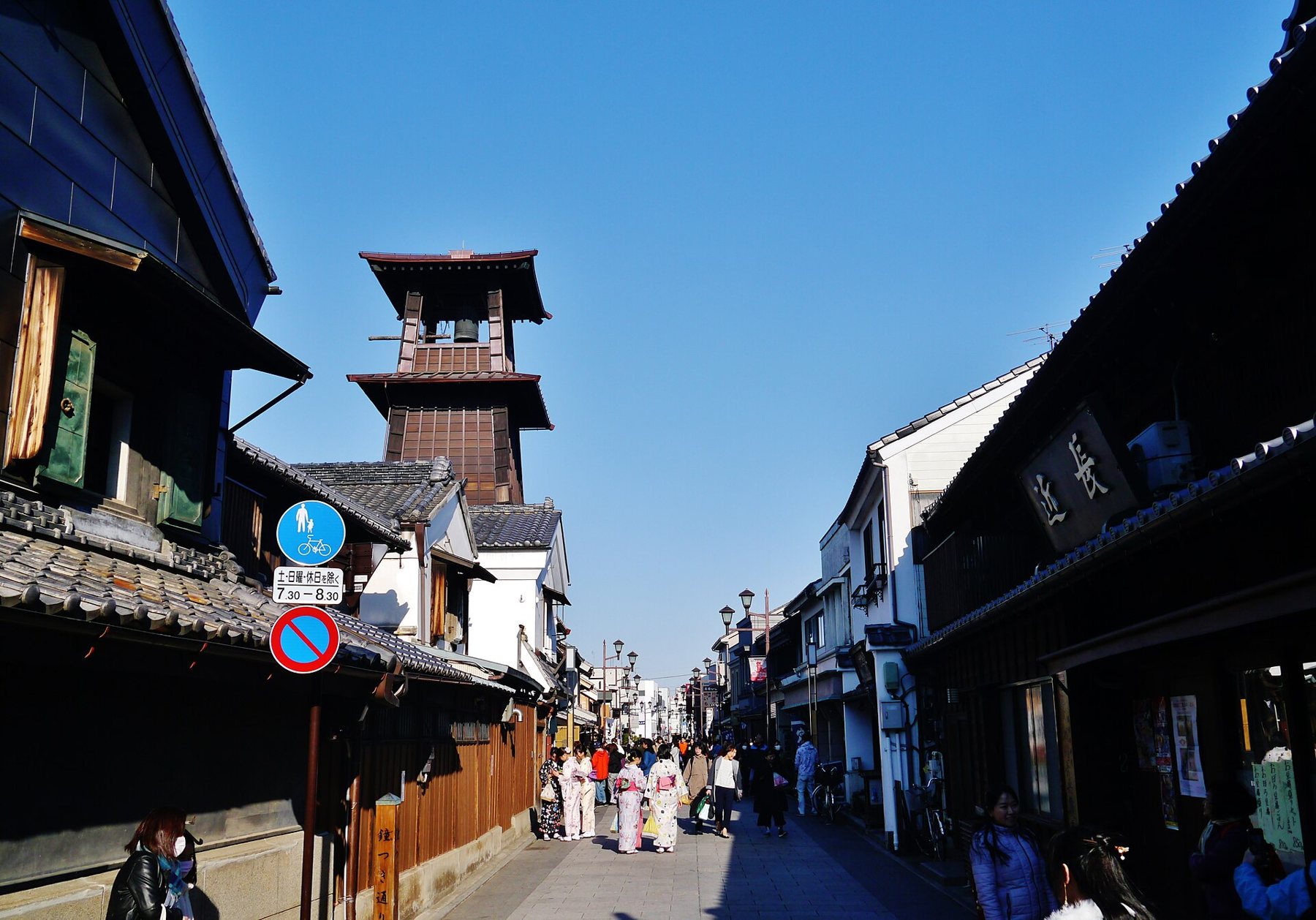
By eleven on a Saturday the main street of Kawagoe moves at the pace of the slowest ice-cream cone. At nine it is a different town: shopkeepers sliding back heavy wooden doors, a delivery van idling, the bell tower throwing a long shadow across an almost empty road. The whole case for this trip is timing, so this guide is built around the order of the day rather than a list of sights.
Kawagoe sits in Saitama Prefecture, inside the first ring of trips from central Tokyo. It earned the nickname Koedo, "little Edo", because it traded so closely with the capital along the Shingashi River in the Edo period, and because a stretch of its centre still looks the part.
Three ways in, one good one for an early start
Kawagoe has three stations, and which one you use shapes the walk.
- Tobu Tojo line from Ikebukuro to Kawagoe or Kawagoeshi station: the quickest, about 30 minutes on an express. Kawagoeshi is a little closer to the old streets.
- Seibu Shinjuku line from Seibu-Shinjuku to Hon-Kawagoe: slower on local trains, but there is a limited express with reserved seats if you start on the west side of the city.
- JR Kawagoe line, which shares Kawagoe station with Tobu and links to the Saikyo line.
From any of them it is a walk of 15 to 25 minutes north to the storehouse district, mostly along a long shopping street. Town loop buses run too, which helps on the way back if your feet are done. If you are unsure which ticket covers what, the notes in which ticket for a day out walk through the regional passes in general terms. Check current details before you go, since offers change.
Start at Kita-in, before the street wakes
Kita-in is a Tendai Buddhist temple about ten minutes east of the main street, and it is the right first stop because its grounds open early and the crowds arrive late. The temple had close ties to the Tokugawa shoguns, and several of its buildings were moved here from Edo Castle in the 17th century, including rooms associated with the third shogun, Iemitsu. Those halls are inside the paid area, so check what is open on the day.
The reason most people come is the Gohyaku Rakan: more than five hundred small stone statues of arhats, the Buddha's enlightened disciples, carved over several decades in the late 18th and early 19th centuries. They sit in rows in an enclosed yard, and no two are alike. One laughs, one sulks, one whispers to a neighbour, one scratches his back. An old saying holds that if you look long enough you will find a face like someone you have lost. In the early morning, with the yard quiet, it is easy to spend half an hour reading faces.
The kurazukuri street while the shutters lift
Walk west to Ichibangai, the main street of the old merchant quarter. The buildings here are kurazukuri, a style of storehouse architecture with thick clay walls, heavy tiled roofs and double-hinged doors, finished in black plaster. They were built as fireproof shops and warehouses. Much of central Kawagoe burned in a great fire in 1893, and merchants rebuilt in this style precisely because the few clay-walled buildings had survived. That is why the street feels so uniform: it went up within a few years, by people who had just watched wood burn.
Look up as much as across. The roof ridges are tall and deep, with ornamental tiles at the ends, and many fronts have a second-floor window with thick shutters that could be sealed with clay when fire came near. The Kawagoe City Kurazukuri Museum, in a former tobacco wholesaler's storehouse on this street, lets you see the inside of one: the thickness of the walls is the thing people remember.
That is why the street feels so uniform: it went up within a few years, by people who had just watched wood burn.
Traffic still runs along Ichibangai, and the pavements are narrow, so the early start pays off twice: fewer people, and room to stand back for a photograph without stepping into the road.
The bell, the candy lane and the small streets
A short lane off the main street leads to Toki no Kane, the wooden bell tower that has become the symbol of the town. A bell has rung the hours here since the early Edo period; the present tower is about three storeys of dark timber and was rebuilt after the 1893 fire. It still rings several times a day, and if you happen to be underneath when it does, the sound carries further than you expect for such a slim structure.
North of the main street, Kashiya Yokocho is a short cobbled alley of old-fashioned sweet stalls: hard candies, sugared beans, sticks of dark brown fried dough, and a lot of things made from sweet potato, which Kawagoe has been known for since the Edo period. It is busy almost all day and noisy in a cheerful way. Go once, buy something small, and move on before the tour groups fill it.
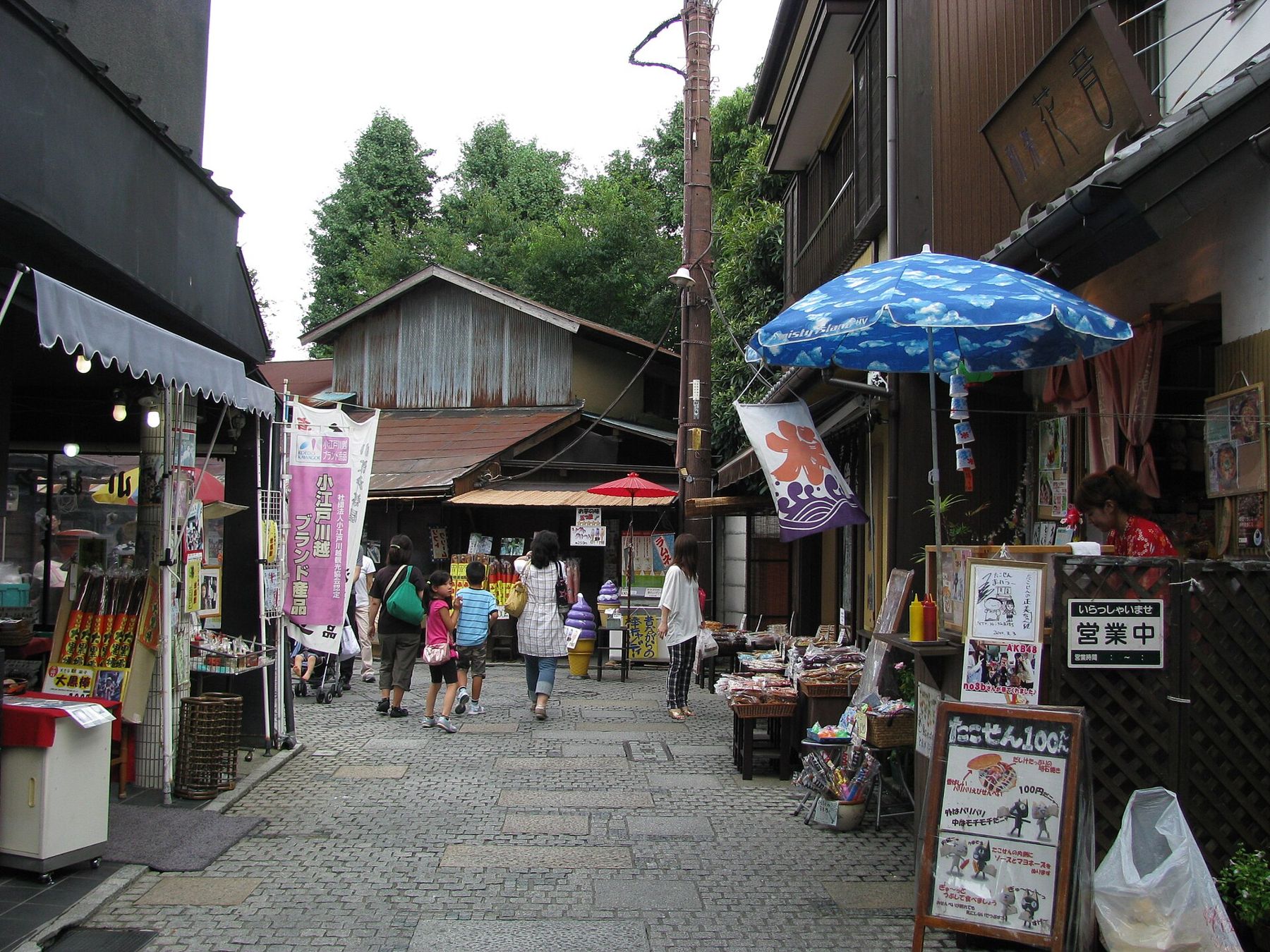
The back streets either side of Ichibangai are worth more time than the main road. Taisho Roman Street, a little south, has early 20th century facades; side lanes hide small temples, wells and gardens where nobody else is standing.
Hikawa Shrine in the afternoon
Kawagoe Hikawa Shrine sits about fifteen minutes' walk north-east of the bell. It is known as a shrine for good relationships, and you will see couples, families and friends in pairs. Its large wooden torii, the gate that marks the entrance to sacred ground at a shrine, is one of the tallest in the country made of wood.
At a shrine, bow lightly as you pass under the torii, and walk to the side of the path rather than down its centre. At the water basin, rinse the left hand, then the right, then pour a little water into your cupped left hand to rinse your mouth, and never drink from the ladle. At the hall, drop a coin in the box, bow twice, clap twice, pause, and bow once more.
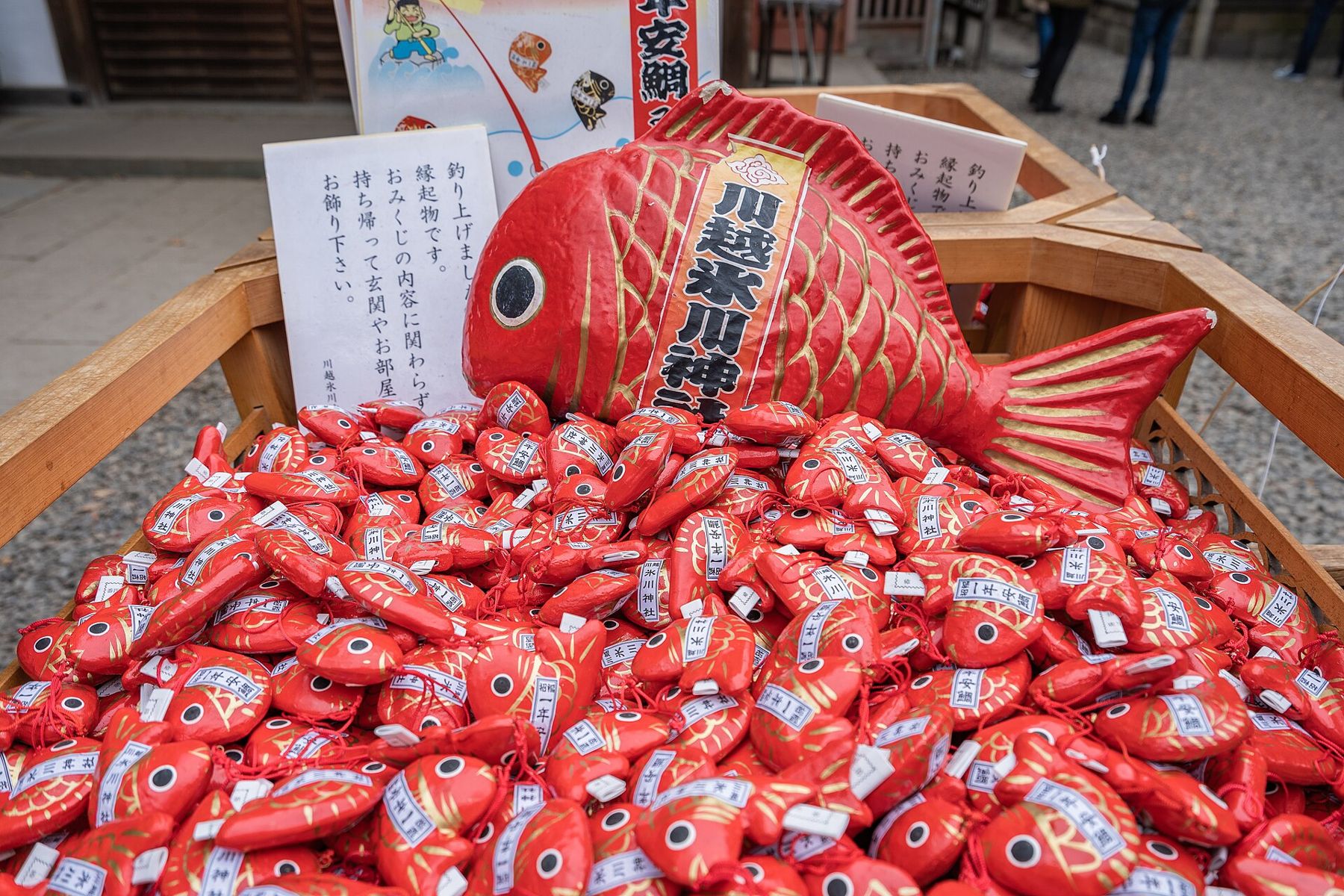
Visitors often "fish" for a fortune here using a small rod to lift a paper sea bream from a tub; the fortune slip is tucked inside the fish. In summer the shrine hangs thousands of glass wind chimes along a passage of the grounds, and in the evening the sound is quieter than you would imagine.
Getting the day right
Kawagoe works best as a slow half-day plus lunch, with the train home in the late afternoon. A few things help:
- Go on a weekday if you can. Weekends from late morning are crowded, and a festival weekend is a different trip entirely.
- Leave Tokyo before eight. The advice in first trains, last trains and the suitcase question applies here: an early train buys you the quiet hours.
- Know the festival. The Kawagoe Festival, held on a weekend in October, brings out tall decorated floats and big crowds. It is part of a group of float festivals that UNESCO lists as intangible cultural heritage. Wonderful if you want it, frustrating if you wanted a quiet look at the architecture.
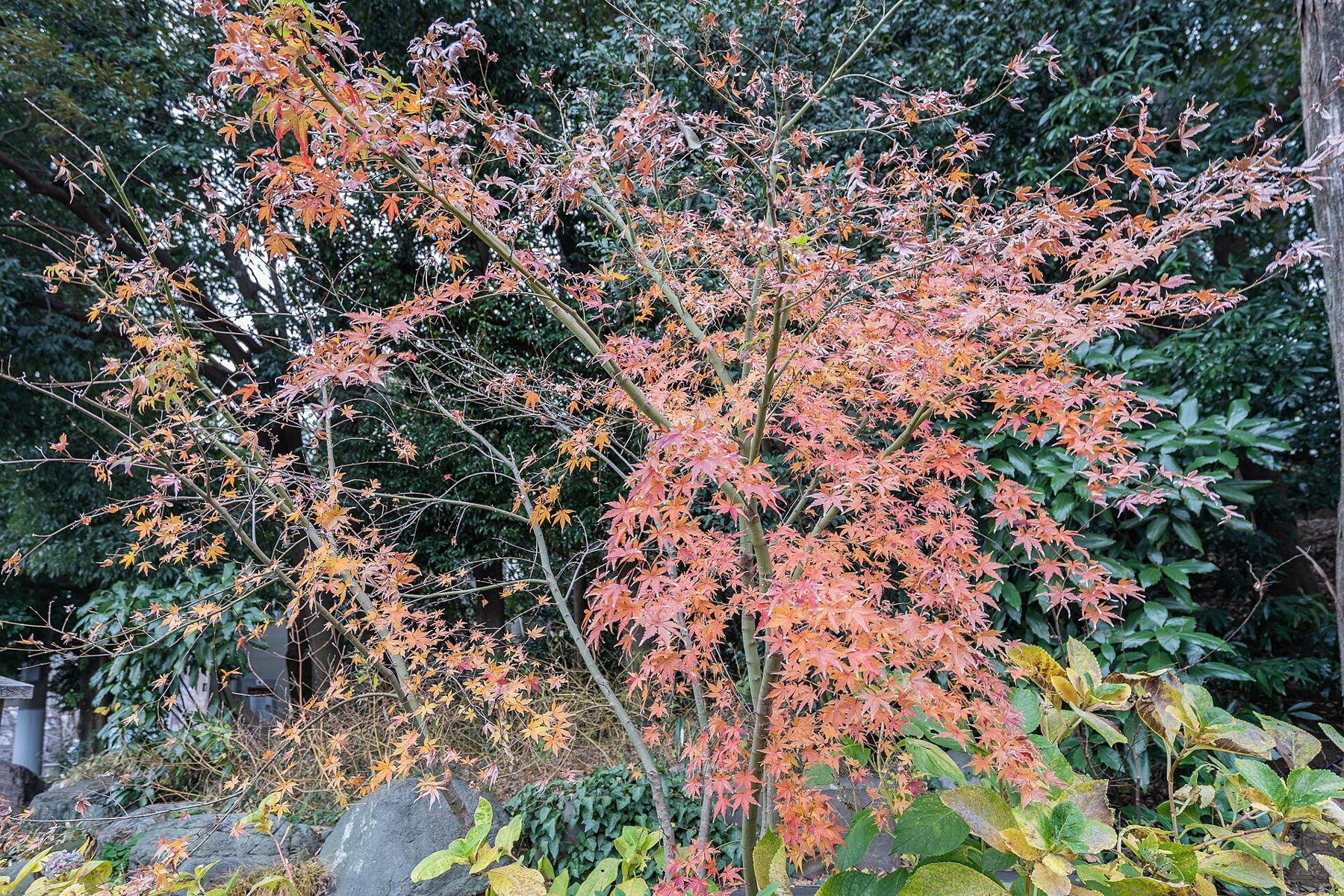
- Pair it with the season. Autumn leaves around the temples and cherry blossom near the Shingashi River change the feel of the day; the calendar in plum, cherry, hydrangea, maple shows which weeks to aim for.
If Kawagoe leaves you wanting a longer ride and more countryside, the Seibu lines carry on west to the mountain valley of Chichibu, a fuller day out but the same kind of old market town at heart.